
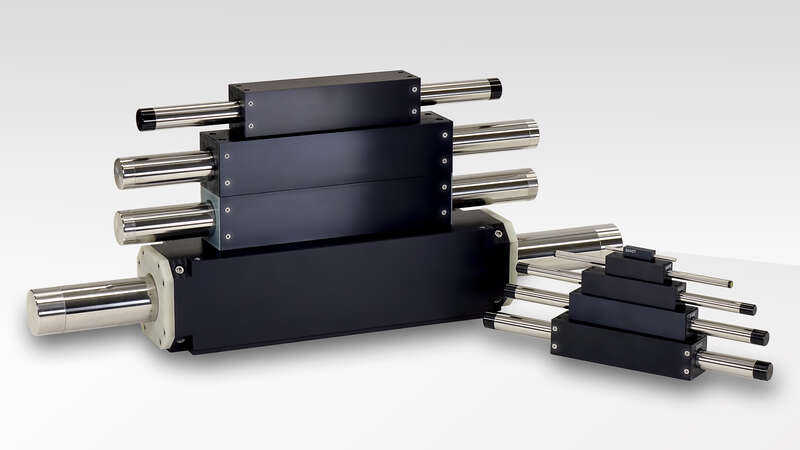
The linear servo motor is a high-precision direct-drive motor. The linear motor consists of a shaft with rare earth iron-boron-neodymium permanent magnets and a runner made of cylindrical coil windings. The shaft provides the magnetic fields on which the runner acts. The driver assembly in combination with the amplifier and the control electronics generates the power for the motor. A small current generates a great force.
Linear shaft motor servos are somewhat unknown in the mechanical engineering market; They have typically been deeply embedded in high-precision OEM systems that handle lithography, wafer scanning, and optical inspection applications. However, in the field of semiconductor automation, they are the motor of choice due to their ultra-precise capabilities. Here are some of the benefits of using linear wave motors for semiconductor manufacturing.
No cogging: Applications that work with nanometer precision require a latch-free motor. The cogging torque occurs in flat linear motors, where the iron core of the motor coil (forcer) reacts with the magnets of the magnetic path or track. This pull to the preferred position of the motor (latching) of the motor causes both power and speed ripple during movement. This is highly undesirable in applications where an absolutely smooth, ripple-free speed or force is required by the motion profile. Neither in the shaft nor in the driver of the NPM motor is iron present, which ensures high precision and latch-free behavior. The coils themselves form the core and thus give the motor the stiffness. The linear servo motors are contactless. Since the coil wraps completely around the magnets, the magnetic flux density is used effectively. This allows a large (0.5 to 5 mm) ring-shaped nominal air gap. This air gap is not critical, in the sense that there are no changes in force. The iron core also ensures large absorption forces between the stator and the fitting and leads to cogging moments in linear movement. U-shaped linear motors, on the other hand, use an epoxy core that does not generate eddy currents or receiving forces. The linear servo motor is designed for motor stiffness that is 100 times higher than that of a U-shaped motor with four times greater heat dissipation than similarly sized flat linear motors.
SIMPLICITY AND RELIABILITY: Mechanical devices used in motion control applications can be very complex, like by the use of complex transmission systems. The linear shaft motor is like a torque motor and can easily simplify complex mechanical tasks. The non-contact linear shaft motor solution consists of a magnetized shaft and a coil part (forcer). The machine designer can quickly integrate the shaft motor into their application, along with the preferred linear bearing arrangement and the desired feedback element (encoder) used to meet the performance requirements. Either the shaft or the forcer can remain fixed, while the other is connected to the load and provides a linear movement. A proved ssuccessful use is in industrial- and cleanroom solutions.
SOLUTION: Choosing the encoder as a feedback part allows the developer to optimize the appropriate resolution and accuracy. Ultimately, the performance limitation lies in the control and feedback elements and not in the capabilities of the shaft motor.
HIGH EFFICIENCY: Shaft motors have the highest efficiency of all other linear technologies due to their circular magnets – round magnets are stacked from end to end in a stainless steel tube (shaft), and the coil part (forcer) wraps around the shaft, taking advantage of the full 360-degree flux generated by the magnets. There is no other approach that is comparable. In an independent study, the linear shaft motor proved to be more than 50 percent more efficient than coreless or U-shaped linear Servos with about 50 percent lower power consumption. Along with the cylindrical design, through which the copper, the current and the magnetic field generate 100% of the force only in the direction of travel with simultaneous moderate heat dissipation.
SMOOTH MOTION PROFILES: The energy efficiency and efficiency of the compact forcer of the linear shaft motor has hardly any heating of its own and is perfect for small spaces where smooth force control is required. Shaft motors are based on a 3-phase brushless motor design and can therefore be driven by almost any brushless servo drive. This provides great flexibility in choosing based on the performance, functionality, and communication protocols of a particular drive.
No lubrication/adjustment maintenance required:
The linear shaft motor requires no grease and shows no drop in performance due to wear/aging. Its maintenance-free long service life contributes to a lifetime cost reduction. The play between wave and driver eliminates the need for settings such as guidance positioning or concentric settings. Dust and noise, as with ball screws and pneumatic systems, do not occur with the linear servo motor. This is not only beneficial in cleanroom applications, but also helps to improve the working environment. The linear shaft motor enables a degree of precision that is not achieved by ball screws. The accuracy of the repeat positioning depends on the resolution of the linear encoder. In addition, sufficient device stiffness is necessary. Also, an absolute positioning precision depends essentially on the linear encoder. It is not dependent on the expansion or contraction caused by the heat of the linear wave motor. In precision operation, other linear mechanisms require strict control of the working environment, including temperature.
Large selection
Nippon Pulse Motor offers a very wide range of linear motors with more than 10,000 standard configurations. If the desired engine variant is not included, a variant can be adapted to the customer's special requirements. For further information or for advice, the product specialists of Dynetics are available.
Further information is available at http://www.dynetics.eu/brochurescatalogues/.
Links:
Video:
Dynetics - Nippon Pulse Linear Shaft Motor - The Next Generation Actuator
NPM Linear Shaft motor: 4-axis multi-drive
Nippon Pulse Simple XYΘ stage for high accuracy applications

STP-K5231A EtherCAT 5-Phase 3-Axis Stepper Drive – Position Compensation
Compatible with most leading masters like ACS, Beckhoff, Omron, Keyence, Panasonic and many more.It supports both external encoder feedback signals from an optical linear encoder and signals from an encoder embedded into a stepper motor offering significant flexibility and enhanced performance for precision motion control.
Read more
Introducing the new TPM ETX-R41K111C compact and easy-to-use EtherCAT ARM-based Automation Controller, designed for seamless multi-axis motion control with up to 30 axes.
Read more
New PM Type 2 Phase Stepper Motor w/ Integrated Gearbox : PFCU Series
With integrated gearbox design, achieving higher torque and thinner form factor.
Effortless gear ratio selection –convenient and hassle free-

Rolled Ball Screws compliant to ISO/ DIN Standards on Ball Nut outer diameter, with accuracy Ct7 ith end-journal machining are available from stock.Suitable for compact and low cost design.
Read more